
 België
 Denmark
 Deutsch
 Español
 Finland
 Français
 Nederlands
 Sweden



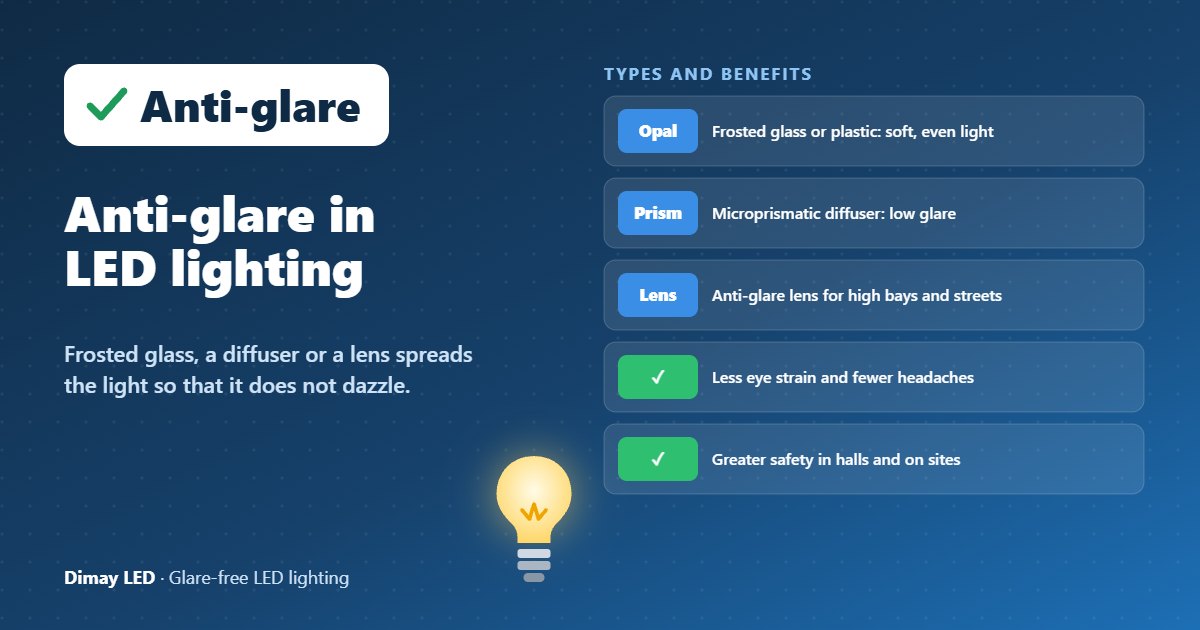
Anti-glare glass, or an anti-glare lens, is a cover that spreads the bright light from LED chips so that the light dazzles less. LEDs are very small, bright points of light. Without a good cover, you look straight into those bright points, which is uncomfortable and tires the eyes.

How does anti-glare work?
An anti-glare cover refracts or scatters the light. As a result, you no longer see a bright point of light, but a more even light surface. There are several versions:
- Opal or frosted glass or plastic: soft, even light distribution.
- Microprismatic diffuser: directs the light so that glare stays low; widely used in panels with UGR<19.
- Anti-glare lens or reflector: on high bays and street lighting, to direct the light and limit direct view of the LED.
Benefits
- less eye strain and fewer headaches,
- better concentration, especially during screen work,
- greater safety in halls, on sites and along roads,
- a calmer and more professional lighting effect.
Where is anti-glare important?
In offices and schools (see UGR), in warehouses with high racking where people look up, and in street and area lighting where glare for road users must be avoided.
Take a look at the anti-glare lenses for high bays and our LED panels.
Frequently asked questions
Does anti-glare glass reduce light output?
Slightly, because part of the light is scattered. With good luminaires, the loss is limited.
What is the difference with UGR?
UGR is the measure of glare; anti-glare glass is one of the ways to achieve a low UGR.
Can I fit an anti-glare lens afterwards?
On some high bays, yes, with a lens that fits the luminaire.


