
 België
 Denmark
 Deutsch
 Español
 Finland
 Français
 Nederlands
 Sweden



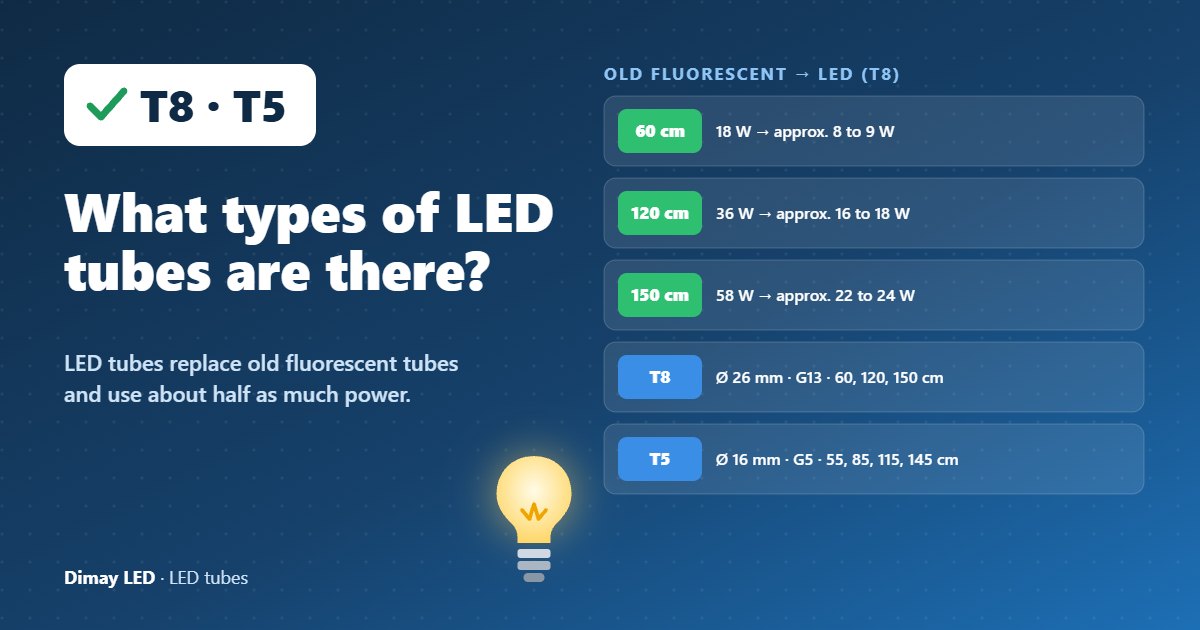
LED tubes come in two main types: T8 with a diameter of 26 mm and a G13 cap, and T5 with a diameter of 16 mm and a G5 cap. The most common lengths are 60, 120 and 150 cm. An LED tube uses about half as much as a traditional fluorescent tube and contains no mercury.

T8 and T5 compared
| T8 | T5 | |
|---|---|---|
| Diameter | approx. 26 mm | approx. 16 mm |
| Cap | G13 | G5 |
| Common lengths | 60, 120, 150 cm | approx. 55, 85, 115, 145 cm |
T5 and T8 are not interchangeable. Always measure the diameter and length of your current tube.
Consumption: old versus LED
| Length | Fluorescent tube | LED T8 (guide) |
|---|---|---|
| 60 cm | 18 W | approx. 8 to 9 W |
| 120 cm | 36 W | approx. 16 to 18 W |
| 150 cm | 58 W | approx. 22 to 24 W |
Replacing a fluorescent tube with LED
How you connect an LED tube depends on the ballast in the luminaire:
- Conventional (magnetic) ballast: replace the starter with the LED starter supplied.
- Electronic ballast: only possible with an LED tube that is suitable for it.
- Directly on mains voltage: the ballast is bypassed; have this done by a qualified electrician.
Colour temperature and CCT
LED tubes are available in K3000 warm white, K4000 neutral white and K6000 cool white. With CCT tubes you set the colour temperature yourself.
Take a look at our T8 LED tubes and LED batten luminaires.
Frequently asked questions
Can I simply put an LED tube in my old fluorescent fitting?
That depends on the ballast. With a conventional ballast you only replace the starter; in other cases modification is needed.
How do I measure the length of a fluorescent tube?
Measure from end to end, including the pins.
Is an LED tube more efficient than a fluorescent tube?
Yes, an LED tube uses about half as much and usually lasts much longer.


