
 België
 Denmark
 Deutsch
 Español
 Finland
 Français
 Nederlands
 Sweden



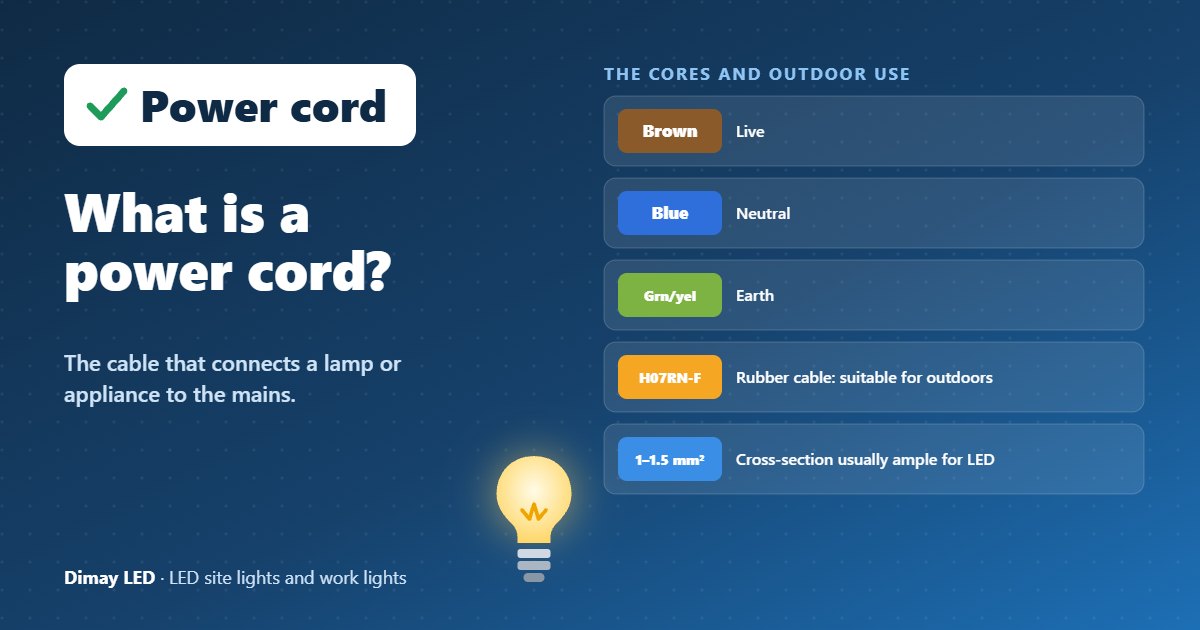
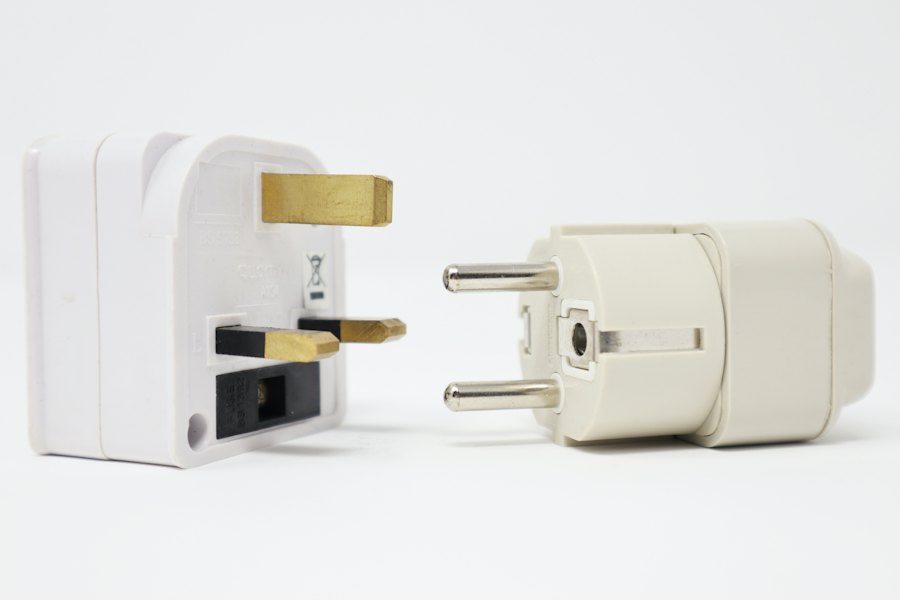
A power cord is the cable used to connect a lamp or appliance to the mains, with or without a plug. LED site lights and work lights often come with a power cord and plug, so you can plug the lamp straight into a socket. For outdoor use and on the building site, that cord must be sturdy and weather-resistant.
The cores in a power cord
| Colour | Function |
|---|---|
| Brown | live |
| Blue | neutral |
| Green/yellow | earth |
Which cable for outdoor use?
For outdoor use and on the building site, a rubber cable is suitable, for example type H07RN-F. It is flexible and resistant to the weather and mechanical stress. An ordinary PVC cable is less suitable for outdoor use and can become stiff in the cold.
Cross-section of the cores
The cross-section, such as 1.0 or 1.5 mm², determines how much current the cable can carry safely. Because LED lighting uses little current, 1.0 to 1.5 mm² is usually more than sufficient. Over long distances or with several appliances on one cable, a thicker cable may be needed.
Safety tips
- Outdoors, use only splash-proof plugs and extension leads.
- Fully unwind a cable reel to prevent overheating.
- Check cords regularly for damage.
- Have fixed outdoor connections carried out by a qualified electrician.
Take a look at our LED work lights and site lights.
Frequently asked questions
Which colour is the live wire in a power cord?
Brown is live, blue is neutral and green/yellow is earth.
Which cable is suitable for outdoor use?
A rubber cable such as H07RN-F is suitable for outdoor use and on the building site.
Can I use an indoor extension lead outdoors?
Preferably not. Outdoors, use a splash-proof extension lead with a rubber cable.


