
 België
 Denmark
 Deutsch
 Español
 Finland
 Français
 Nederlands
 Sweden



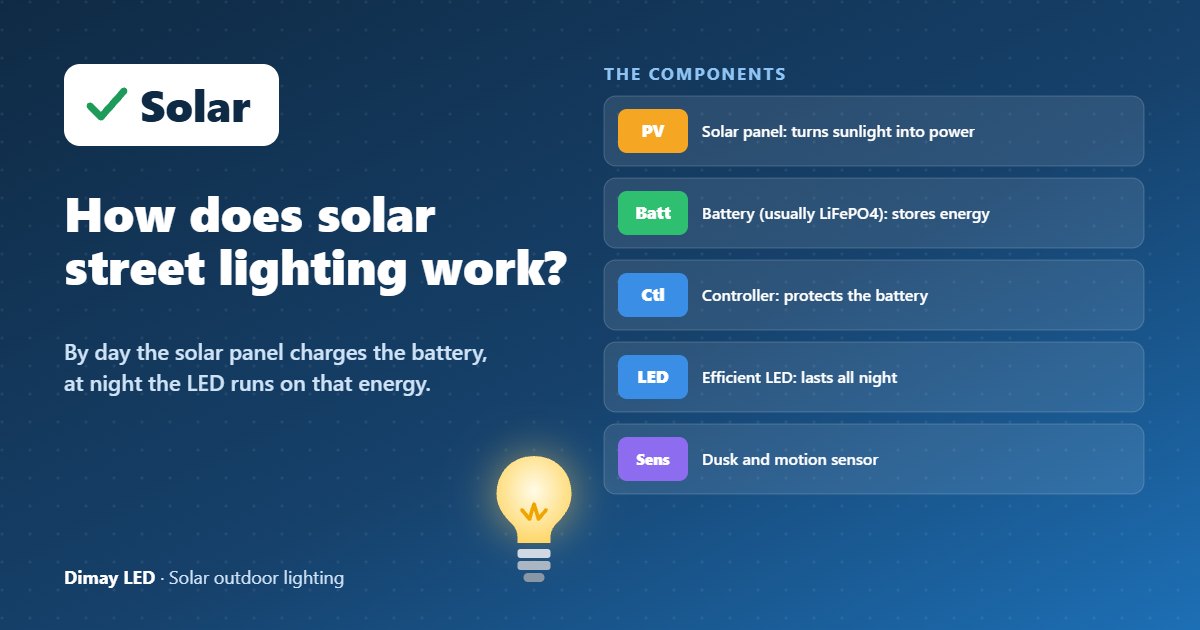
Solar street lighting works with a solar panel, a battery, an LED lamp and a controller. During the day, the solar panel converts sunlight into electricity and charges the battery. When it gets dark, a dusk sensor switches on the LED lamp, which runs on the stored energy. No power cable is needed.
The components
- Solar panel: converts sunlight into electricity.
- Battery: stores the energy, usually a lithium battery (LiFePO4).
- Controller: protects the battery and controls the lamp.
- LED lamp: energy-efficient, so the battery lasts all night.
- Sensors: a dusk sensor and often a motion sensor.
Benefits
- no digging and no cables needed,
- no electricity costs,
- quick to install in remote locations,
- also works during a power cut.
What to look out for
| Feature | What to look for |
|---|---|
| Positioning | solar panel facing south as far as possible, without shade |
| Battery capacity | determines how many nights the lamp runs without sun |
| Motion sensor | dims the lamp when nobody is around, saving the battery |
| IP rating | at least IP65 for outdoor use |
Does solar also work in winter?
Yes, but in a UK and northern European winter there is less sun and the nights are longer. The burning time may then be shorter. A larger solar panel, a larger battery and a motion sensor help to ensure enough light in winter too.
Take a look at our solar outdoor lighting, solar site lights and LED street lighting.
Frequently asked questions
How long does solar street lighting stay on?
That depends on the battery, the solar panel and the season. Longer in summer than in winter.
Does solar lighting work when it is cloudy?
Yes, the panel also charges when it is cloudy, but more slowly.
Do I need an electrician?
No, no connection to the mains is needed.


