
 België
 Denmark
 Deutsch
 Español
 Finland
 Français
 Nederlands
 Sweden



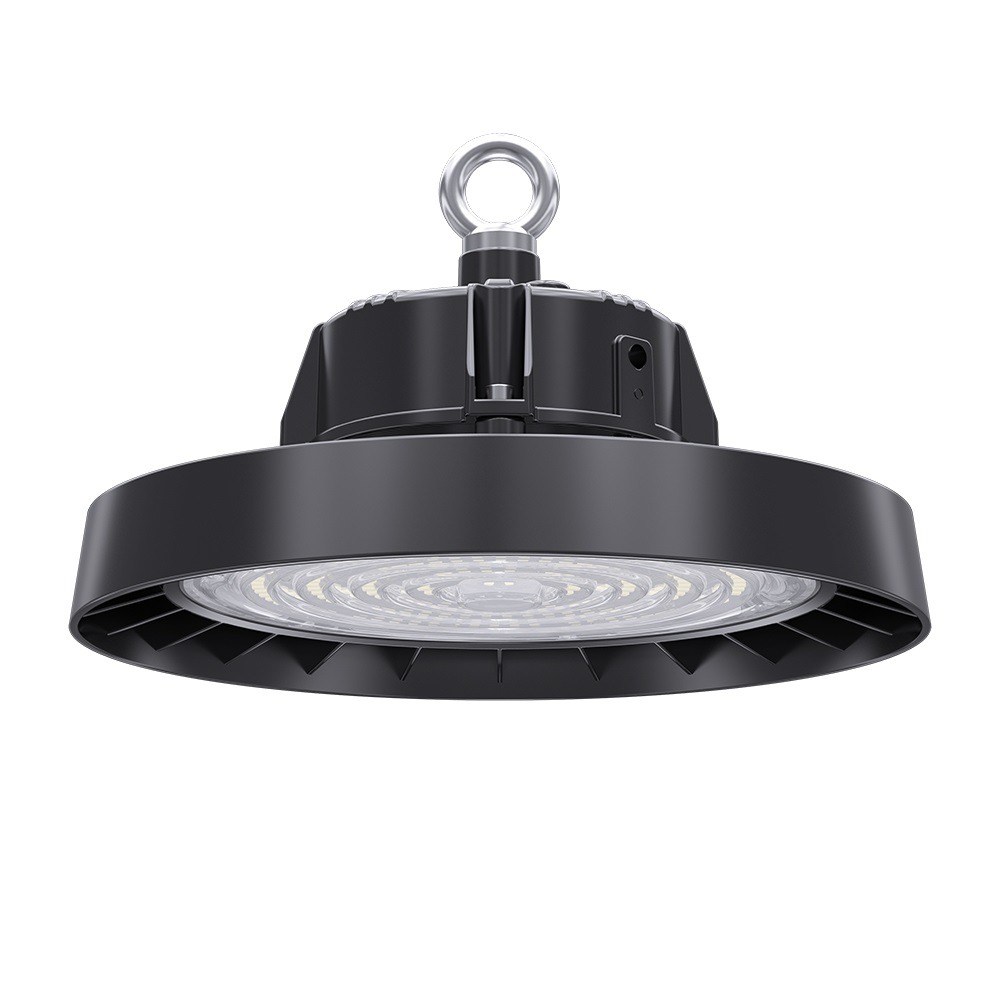
An LED high bay, also called a UFO light or warehouse light, is made for high spaces such as warehouses, workshops, production halls, barns and sports halls. But at what height do you mount it, how many watts do you choose and which beam angle suits your hall? In this article we set it out step by step, with a clear table and a worked example.
From what height do you choose a high bay?
A high bay is intended for ceilings from about 5 metres. Below 4 to 5 metres a high bay quickly gives too much light directly under the fitting and a risk of glare. For lower spaces, LED panels or LED batten fittings are usually a better choice. From 5 metres up to well over 12 metres the high bay is ideal: one fitting lights a large area and is quick to hang.
Table: ceiling height, wattage and beam angle
| Mounting height | Wattage per fitting | Beam angle | Spacing between fittings |
|---|---|---|---|
| 5 – 6 metres | 100 watts | 120° | 5 – 6 metres |
| 6 – 8 metres | 150 watts | 90° or 120° | 6 – 8 metres |
| 8 – 10 metres | 200 watts | 90° | 7 – 9 metres |
| 10 – 12 metres | 240 watts | 60° or 90° | 8 – 10 metres |
| above 12 metres | 240 watts | 60° | 8 – 10 metres |
These values apply to an average warehouse or workshop. If you want more light, for example for detailed work or a sports hall, choose one step up in power or hang the fittings a little closer together.
Which beam angle suits your hall?
The beam angle determines how widely the light spreads. A 120° lens gives a wide beam and suits lower halls up to about 7 metres. A 90° lens is the best all-rounder for halls of 7 to 10 metres. A 60° lens concentrates the light and brings it all the way to the floor in halls of more than 10 metres, or in narrow aisles between high racking. If you hang a wide lens very high, a lot of light is lost on the walls and at the top of the racking.
How far apart do the fittings hang?
A simple rule of thumb: the distance between two high bays is roughly equal to the mounting height, and never more than one and a half times that height. If you hang the lights at 8 metres, there will be a fitting about every 7 to 8 metres. Along the walls, keep half that distance. This prevents dark strips between the lights and along the walls.
Worked example: workshop of 20 by 30 metres, 8 metres high
At 8 metres the table suggests 150 to 200 watts with a 90° lens. With a spacing of about 6 metres you get 4 rows of 5 fittings, so 20 high bays. With 20 fittings of 150 watts, each giving about 22,500 lumens, you reach some 400 to 450 lux on the floor. That is more than enough for a workshop. For a storage hall where 150 to 200 lux is enough, 20 fittings of 100 watts or fewer 150 watt fittings will do.
Mounting: hook, chain or bracket
A high bay is usually hung from a hook with a steel wire or chain, or fixed directly to the ceiling or a beam with a mounting bracket. Hang the fitting below the roof purlins and above the crane rail or the highest racking, so that the light can shine down freely. In sports halls, use a ball guard and an anti-glare lens. Always have the connection made by a qualified electrician.
Advice for your hall
Not sure about the height, the wattage or the number of fittings? Email the dimensions and height of your hall and how it is used to info@dimay.com and we will calculate it for you. Also see our LED high bay lighting and the linear high bays, and read more about what an LED high bay is and about high bays with an anti-glare lens.
Frequently asked questions about mounting high bays
What is the minimum height for an LED high bay?
A high bay is intended for ceilings from about 5 metres. With a lower ceiling, LED panels or LED batten fittings are a better choice, because a high bay then becomes too bright and dazzling.
How many watts of high bay do I need at 8 metres?
At 6 to 8 metres, 150 watts is usual; at 8 to 10 metres, 200 watts. For a storage hall with low lighting needs you can choose one step lower.
Which lens should I choose: 60, 90 or 120 degrees?
Choose 120° up to about 7 metres, 90° for 7 to 10 metres, and 60° above 10 metres or in narrow aisles between high racking.
How far apart should I hang high bays?
As a rule of thumb, keep a spacing roughly equal to the mounting height, with a maximum of one and a half times that height. Along the walls, keep half that distance.
Can I dim a high bay?
Yes, there are dimmable high bays with 1-10V or DALI. This lets you adjust the light to the task or combine it with a motion or daylight sensor to save even more energy.


