
 België
 Denmark
 Deutsch
 Español
 Finland
 Français
 Nederlands
 Sweden



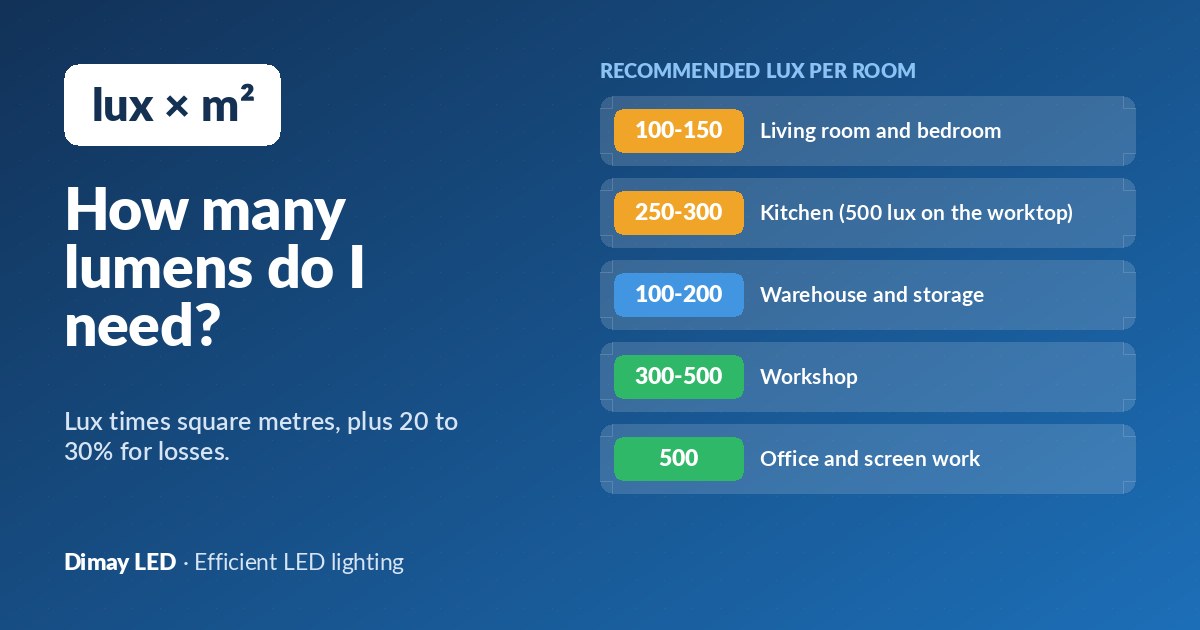
When choosing LED lighting you look at lumens rather than watts. Lumens tell you how much light a lamp gives, while watts only tell you how much electricity it uses. How many lumens you need depends on the size of the room and what you do in it.
The rule of thumb: lux times square metres
The amount of light falling on a surface is measured in lux. One lux is one lumen per square metre. Multiply the lux level you want by the floor area of the room and you know how many lumens you need in total. Because part of the light ends up on walls and ceiling, add around 20 to 30 percent in practice, and a little more with high ceilings or dark walls.
Guide values per room
In a living room or bedroom, 100 to 150 lux is enough for general lighting, supplemented with accent lighting. In a kitchen, 250 to 300 lux is a good basis, with around 500 lux on the worktop. A bathroom needs about 200 to 300 lux. Offices and workstations with screens are lit to 500 lux, workshops to 300 to 500 lux depending on the work, and storage areas and warehouses to 100 to 200 lux.
Worked example: a 20 m² office
A 20 m² office at 500 lux needs 20 times 500, which is 10,000 lumens. With about 25 percent extra for losses you arrive at roughly 12,500 lumens. A 60x60 cm LED panel often gives around 3,500 to 4,000 lumens, so three to four panels light the office well. Choose panels with UGR below 19 to avoid glare on screens.
Also consider colour temperature and distribution
Besides the amount of light, the colour temperature and the distribution determine how pleasant a room feels. Spread the fittings evenly across the ceiling so that no dark corners appear. If you would like an exact lighting calculation for your room, contact us via the chat or by email.
Also see our LED Panels and LED High Bay Lighting. Not sure which lighting you need? Email us at info@dimay.com and we will be happy to help.


