
 België
 Denmark
 Deutsch
 Español
 Finland
 Français
 Nederlands
 Sweden



LED lighting sometimes costs more to buy than old lighting, but it uses far less electricity and lasts much longer. Especially in business premises where the lights are on for many hours a day, the investment often pays for itself quickly. A simple calculation shows in advance what the switch will deliver.
Step 1: calculate the difference in power
Add up the power of all current lamps, including the consumption of ballasts, and do the same for the new LED lighting. The difference between the two is the power you save, expressed in watts.
Step 2: calculate the annual saving
Multiply the power saved by the number of operating hours per year and divide by 1,000 to get the number of kilowatt hours saved. Multiply that by your electricity price per kilowatt hour and you know how much you save each year.
Step 3: divide the investment by the saving
Divide the total investment, meaning the lighting plus any installation costs, by the annual saving. The result is the payback time in years.
Worked example: a warehouse
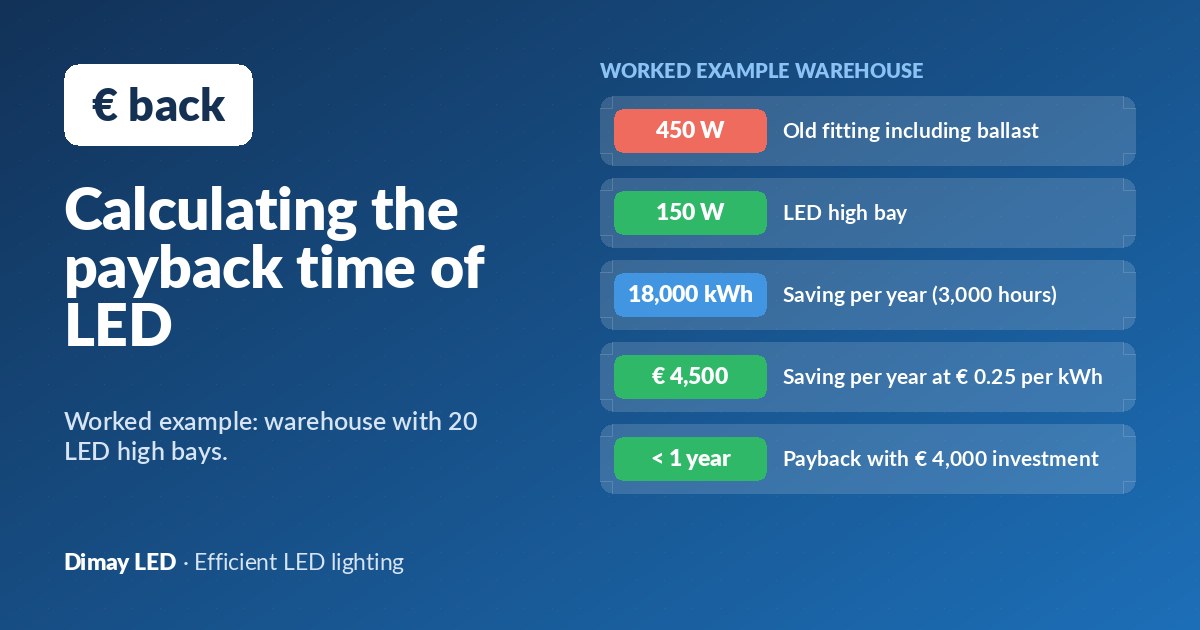
Suppose a warehouse has twenty old 400-watt fittings that use about 450 watts each including the ballast. They are replaced by 150-watt LED high bays. Each fitting saves 300 watts, which is 6,000 watts for twenty fittings. If the lights are on for 3,000 hours a year, that is 18,000 kilowatt hours. At an electricity price of 0.25 euros per kilowatt hour you save 4,500 euros a year. If the new lighting including installation costs, for example, 4,000 euros, the investment pays for itself in less than a year.
Additional benefits
Besides a lower electricity bill you save on maintenance, because LED lasts much longer than traditional lamps. With dimmable fittings or fittings with a motion or daylight sensor you can save even more. For a calculation for your own situation, send us the number and type of your current lamps via the chat or by email.
Also see our LED Panels and LED High Bay Lighting. Not sure which lighting you need? Email us at info@dimay.com and we will be happy to help.


