
 België
 Denmark
 Deutsch
 Español
 Finland
 Français
 Nederlands
 Sweden



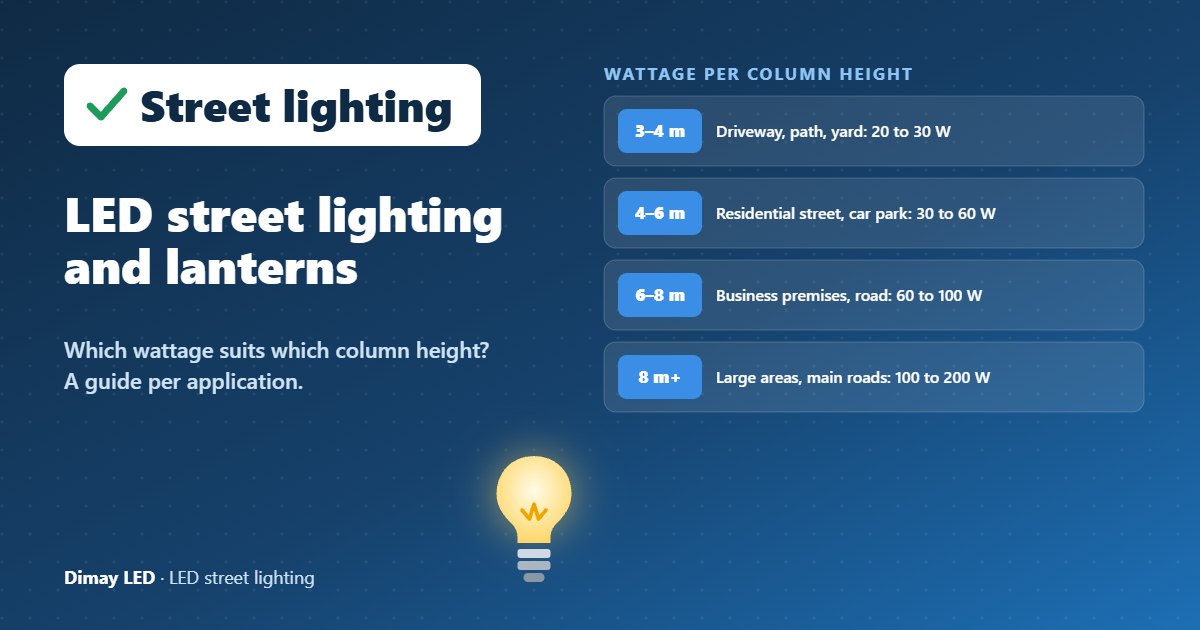
LED street lighting consists of luminaires on lighting columns that light roads, paths, car parks, business premises and driveways. They use much less electricity than old sodium or mercury lamps, last much longer and give full light instantly. Classic lanterns can often be converted with a powerful LED bulb.
Which wattage for which column height?
| Column height | Application | Wattage (guide) |
|---|---|---|
| 3 to 4 metres | driveway, garden path, yard | approx. 20 to 30 W |
| 4 to 6 metres | residential street, car park | approx. 30 to 60 W |
| 6 to 8 metres | business premises, access road | approx. 60 to 100 W |
| 8 metres and higher | large areas, main roads | 100 to 200 W |
Key features
- IP65 or higher: resistant to dust and rain.
- IK08 or IK09: impact-resistant and vandal-resistant.
- Dusk sensor: automatically on at sunset and off at sunrise.
- Colour temperature: 4000 K for business areas; warmer light (3000 K) for residential areas and nature areas.
- Anti-glare lens: less glare for traffic and local residents.
Converting classic lanterns to LED
If you have classic lamp posts with an E27 socket, you can often replace the old bulb with a powerful LED Parisienne E27 bulb. Do check that the bulb fits inside the lantern and that the luminaire is suitable for outdoor use.
Take a look at our LED street lighting, accessories and read how solar street lighting works.
Frequently asked questions
How much does LED street lighting save?
Often 50 to 70% compared with old sodium or mercury lamps.
Can I convert an existing lamp post to LED?
Often yes, with an LED luminaire on the column or a powerful LED E27 bulb in a classic lantern.
What does a dusk sensor do?
It automatically switches the lighting on when it gets dark and off when it gets light.


