
 België
 Denmark
 Deutsch
 Español
 Finland
 Français
 Nederlands
 Sweden




Lux (lx) is the unit of illuminance: the amount of light falling on a surface. One lux is one lumen per square metre. Whereas lumens tell you how much light a lamp emits, lux tells you how much light actually reaches, for example, a desk, workbench or floor.
The difference between lumens and lux
A 4,000-lumen lamp gives a lot of lux up close, but much less at a greater distance or spread over a large area. The lux at a given spot therefore depends on the light output, the distance, the beam angle and the reflection from walls and ceiling.
How many lux do you need?
The European standard EN 12464-1 gives guide values for indoor workplaces. Some examples:
| Room or task | Guide value |
|---|---|
| Corridors and circulation areas | approx. 100 lux |
| Warehouse and storage | approx. 100 to 200 lux |
| Canteen, toilet, changing room | approx. 200 lux |
| Office work, reading, writing | 500 lux |
| Fine work, technical drawing | 750 lux or more |
At home there are no fixed requirements. As a guide: a living room generally needs approx. 100 to 200 lux, a kitchen worktop or desk 300 to 500 lux.
How do you measure lux?
You measure lux with a lux meter or, as a rough guide, with a smartphone app. Measure at working height, for example on the desk, at several points in the room.
More lux with fewer lamps
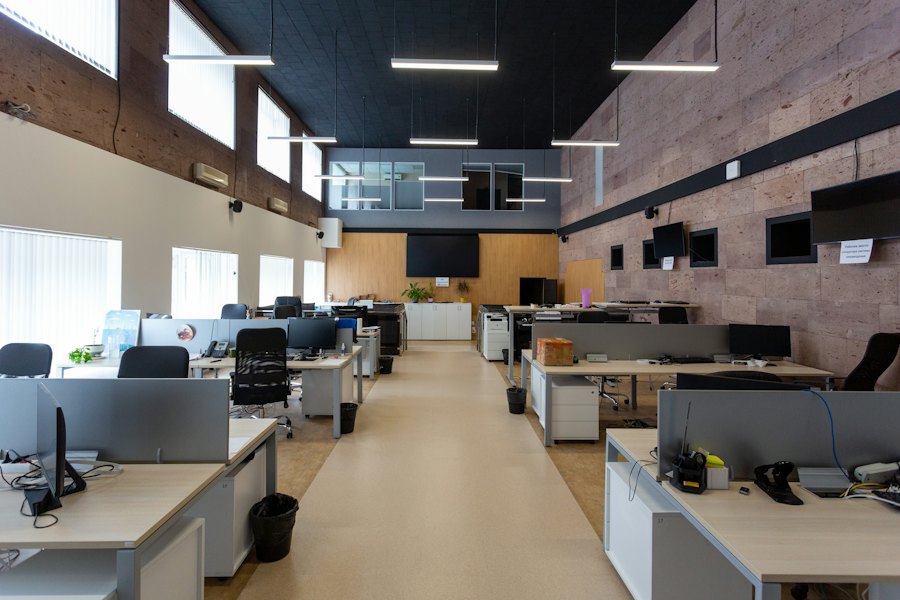
With efficient luminaires you achieve the desired light level with less power. In high halls, LED high bay luminaires provide enough lux on the floor; in offices, LED panels do the job.
Frequently asked questions
How many lux are needed in an office?
For office work, 500 lux on the work surface is the usual guide value according to EN 12464-1.
What is the difference between lux and lumens?
Lumens are the amount of light a lamp emits; lux is the amount of light falling on a surface.
How many lux does a warehouse need?
For storage and walkways, approx. 100 to 200 lux is usual; more is needed for order picking or reading labels.


