
 België
 Denmark
 Deutsch
 Español
 Finland
 Français
 Nederlands
 Sweden



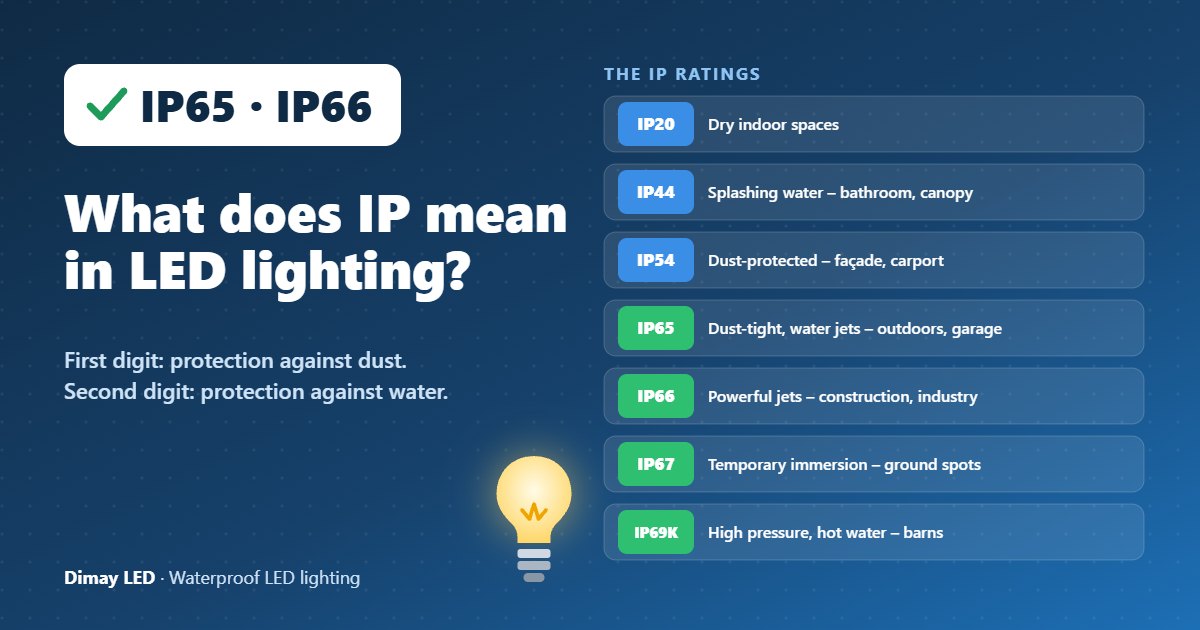
IP stands for Ingress Protection: a code from the EN 60529 standard that indicates how well a luminaire is protected against the ingress of solid particles and water. The first digit relates to dust and contact (0 to 6), the second to water (0 to 9). The higher the digits, the better the protection.
The most common IP ratings
| IP rating | Protection | Application |
|---|---|---|
| IP20 | against contact with fingers, not against water | dry indoor spaces |
| IP44 | against objects larger than 1 mm and splashing water | bathroom (outside the shower zone), canopy |
| IP54 | dust-protected and splash-proof | façade, carport, sheltered outdoor spot |
| IP65 | dust-tight and resistant to water jets | outdoors, garage, workshop |
| IP66 | dust-tight and resistant to powerful water jets | construction site, industry, grounds |
| IP67 | dust-tight and resistant to temporary immersion | ground spotlights, places with puddles |
| IP69K | resistant to high-pressure and hot-water cleaning | livestock barns, food industry |
Which IP rating do you need?
- Living room, office: IP20 is sufficient.
- Bathroom: IP44 or higher depending on the zone; directly above or in the shower often IP65.
- Outdoors under a canopy: IP44 to IP54.
- Outdoors, exposed to the elements: IP65 or IP66.
- Damp or dusty commercial spaces: IP65 or IP66, for example waterproof LED batten luminaires.
IP and IK: not the same
The IP rating concerns dust and water. The IK rating concerns impact resistance, for example IK08 (5 joules) or IK10 (20 joules). For sports halls, car parks and public spaces, the IK rating is important too.
Also take a look at our IP65 and IP66 LED site lights.
Frequently asked questions
What is the difference between IP65 and IP66?
Both are completely dust-tight. IP65 is resistant to water jets, IP66 to powerful water jets.
Which IP rating do I need in the bathroom?
Outside the shower zone, IP44 is usually sufficient. In or directly above the shower, choose IP65.
What does an X in the IP code mean, as in IPX4?
The X means that digit has not been tested. IPX4 has therefore been tested for splashing water, but not for dust.


